Sign in


Short answer. Carriers charge extra for boxes that are long or bulky. UPS and FedEx add an Additional Handling charge when the longest side is over 48 inches, the second longest over 30 inches, length plus girth over 105 inches, or the volume over 10,368 cubic inches. Bigger boxes, over 96 inches long or 130 inches in length plus girth, get a Large Package or Oversize charge. USPS adds nonstandard fees for parcels over 22 inches long, over 30 inches long, or over 2 cubic feet. The best way to avoid all of them is a smaller box.
Three systems for large boxes
Each carrier has its own rules, and the thresholds are not the same.
- UPS and FedEx Additional Handling. A charge for packages that are long, wide, bulky, heavy or in non-standard packaging.
- UPS Large Package Surcharge and FedEx Oversize Charge. A much larger charge for the biggest packages, with a minimum billable weight.
- USPS nonstandard fees. Smaller fees that start at lower sizes, for Priority Mail and USPS Ground Advantage.
On top of these, every carrier may bill a large, light box by dimensional weight. The surcharges are added to the dimensional weight rate, not used instead of it.
How to measure length and girth
- Length is the longest side of the box.
- Girth is the distance around the box at its thickest part: 2 x width plus 2 x height.
- Length plus girth is the two added together.
Example: a box of 40 x 20 x 15 inches has a girth of 2 x 20 plus 2 x 15, which is 70 inches. Length plus girth is 40 plus 70, which is 110 inches.
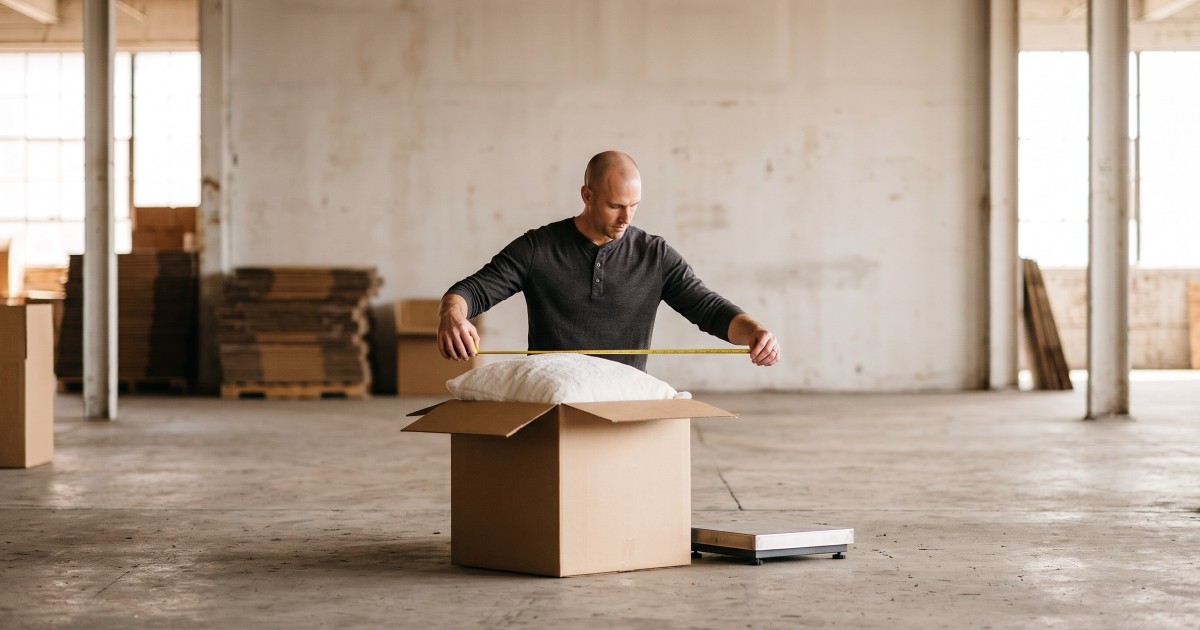
Measure the packed box at its widest points, including bulges, and round up to the next whole inch, as UPS does. Our help article on how to weigh and measure a package shows the steps.
UPS and FedEx: Additional Handling
As of November 2026, both carriers apply Additional Handling to a domestic package that meets any of these size rules:
- Longest side. UPS: Over 48 in. FedEx: Over 48 in.
- Second longest side. UPS: Over 30 in. FedEx: Over 30 in.
- Length plus girth. UPS: Over 105 in. FedEx: Over 105 in.
- Cubic volume. UPS: Over 10,368 cubic in. FedEx: Over 10,368 cubic in.
- Soft pack (poly bag, bubble mailer). UPS: Over 18 x 14 x 6 in. FedEx: Over 18 x 13 x 5 in.
The cubic volume rule is new for 2026. FedEx lists it as effective January 12, 2026.
Packaging rules also apply. A package that is not in a corrugated cardboard box, is round or cylindrical (tubes, buckets, drums), is wrapped in shrink wrap, or has straps, handles or wheels can trigger the charge at both carriers.
Minimum billable weight: 40 lb. When Additional Handling is triggered by size, both UPS and FedEx bill the package at no less than 40 lb, even if it weighs less.
Amount. As of November 2026, the size version is listed at $30 to $40.50 per package at UPS daily rates and $29.50 to $40.75 at FedEx list rates, depending on zone. UPS charges only one Additional Handling fee per package, even if several rules apply.
UPS and FedEx: Large Package and Oversize
The biggest packages move to a separate, higher charge. As of November 2026, a domestic package is a Large Package at UPS, or gets the Oversize Charge at FedEx, when it:
- is over 96 inches on its longest side, or
- is over 130 inches in length plus girth, or
- is over 17,280 cubic inches, or
- weighs over 110 lb.
Minimum billable weight: 90 lb. Both carriers bill these packages at no less than 90 lb.
Amount. As of November 2026, it is listed at $219.50 to $331 per package at UPS daily rates, and $255 to $330 at FedEx list rates, by zone and, at UPS, by commercial or residential delivery. UPS does not add Additional Handling when the Large Package Surcharge applies.
The hard limits are 108 inches in length and 165 inches in length plus girth, at both carriers. Above that, the package is not accepted as a parcel.
These are published list amounts. Fuel and seasonal demand surcharges can be added on top, and your actual price depends on the rate you buy at.
USPS: nonstandard fees
USPS uses smaller fees that start at smaller sizes. They apply to Priority Mail and USPS Ground Advantage, retail and commercial.
- Length over 22 in, up to 30 in. Priority Mail: $4.50. Ground Advantage: $4.50.
- Length over 30 in. Priority Mail: $21.00. Ground Advantage: $10.00.
- Volume over 2 cubic feet (3,456 cubic in). Priority Mail: $35.00. Ground Advantage: $21.00.
Amounts are from the USPS price list effective October 4, 2026, current as of November 2026.
A few details:
- A parcel can pay both a length fee and a volume fee.
- For round or other non-rectangular parcels, USPS multiplies the volume by 0.785 before comparing it to 3,456 cubic inches.
- USPS also has a $4.50 fee for some shapes and contents, such as tubes and rolls.
- Priority Mail stops at 108 inches in length plus girth. Ground Advantage goes up to 130 inches, but from 108 to 130 inches it charges a fixed oversized price regardless of weight. The nonstandard fees do not apply on top of that price.
Two examples
Box A: 40 x 20 x 15 inches. Length plus girth is 110 inches, and the volume is 12,000 cubic inches.
- UPS and FedEx: over 105 inches and over 10,368 cubic inches, so Additional Handling applies.
- USPS Priority Mail: over 108 inches, so it is not accepted.
- USPS Ground Advantage: between 108 and 130 inches, so the oversized price applies.
Box B: 24 x 18 x 12 inches. Length plus girth is 84 inches, and the volume is 5,184 cubic inches.
- UPS and FedEx: below every Additional Handling size rule.
- USPS: over 22 inches long and over 2 cubic feet, so both fees apply: $39.50 with Priority Mail or $25.50 with Ground Advantage, as of November 2026.
The lesson: a box that is fine at UPS and FedEx can still pay USPS fees, and the reverse. Cutting Box B to 21 x 16 x 10 inches (3,360 cubic inches) removes both USPS fees.
How to avoid oversized charges
Right-size the box. Measure the item, add only the cushioning it needs, and pick the smallest box that fits. Watch the lines that matter: 22 and 30 inches long for USPS, 48 inches long and 30 inches wide for UPS and FedEx, and the volume limits.
Disassemble when you can. Remove legs, handles, stands and other parts that add length. Pack them alongside the item or in a second box.
Ship flat. Flat-pack furniture, frames and panels in a thin box instead of a deep one. Length plus girth drops quickly when the height is small.
Avoid tubes and odd shapes when a box works. Cylinders trigger Additional Handling at UPS and FedEx and a USPS fee. A narrow rectangular box is often a better choice.
Keep soft packs within the limits. A large poly bag over 18 inches long can trigger Additional Handling. A box may cost less.
Compare more than one carrier. Since the thresholds differ, the cheapest carrier for a large box depends on its exact size.
Enter true dimensions. Carriers can measure packages in their network and bill the difference later. FedEx states that dimensions may change in transit and that it may adjust charges. See carrier adjustments for how this works.
Oversized packages in LogiRates
LogiRates compares USPS, UPS and FedEx rates for the parcel you enter, within the United States. Enter the real weight and box size, and each carrier's rate reflects that box. The rate calculator works without an account, and the final price is shown before you pay.
You can save shipping templates for the box sizes you use most often, so you enter the right dimensions every time.